

MOST Polish-Hungarian Youth Forum: Summer University in Budapest
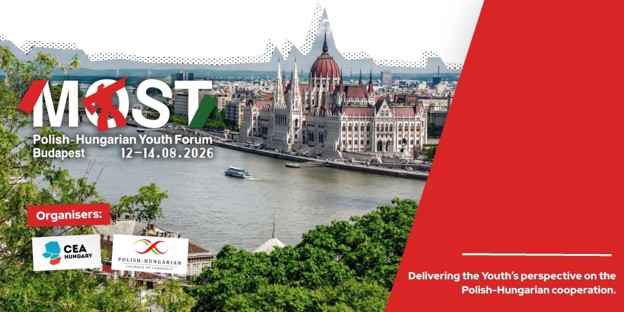
Polish-Hungarian Relations Through the Eyes of Young Intellectuals – Central Europe Association and Polish-Hungarian Economic Chamber Organise Three-Day Summer University in Budapest
Budapest, 12–14 August 2026
The first Polish-Hungarian Summer University, held under the name MOST Polish-Hungarian Youth Forum, was successfully organised in Budapest from 12–14 August, attracting significant interest. The aim of the programme was to encourage the generation newly entering the labour market to view the centuries-old Polish-Hungarian friendship not merely as a historical tradition, but as a living relationship and a unique opportunity for economic, diplomatic and social cooperation, giving new momentum to bilateral relations.
The three-day programme took place at the Károlyi-Csekonics Palace and consisted of panel discussions, presentations and interactive activities examining different aspects of cooperation. Topics included economic development following Poland’s and Hungary’s accession to the European Union, democracy and current political developments, Polish and Hungarian approaches to security policy, as well as the future of the Visegrád Four.
A key objective of the conference was to ensure that young people’s own perspectives were strongly represented. Around 50 Polish and Hungarian students had the opportunity to share their views through professional workshops, debates and a World Café led by young experts, focusing on Polish-Hungarian relations and the future of Central Europe.
Particular attention was given to the panel discussion “Gen Z’s Central Europe – Central European identity and Polish-Hungarian friendship in the eyes of young adults,” which explored the identity of the younger generation, the future of Polish-Hungarian friendship and Gen Z’s perspective on Central Europe. The panel featured Boglárka Bálint, Project Coordinator at the Polish-Hungarian Economic Chamber; Stanisław Apriłaszwili, journalist/editor at TVP S.A.; and Balázs Bukits, Chief Organizer of the Central Europe Association. The discussion was moderated by Anna Jakubowska, Managing Director of Pentalingua Translations.
One of the key messages of the economic programme was that human capital, knowledge and skills are fundamental to successful economic development. The economic cooperation panel featured Zoltán Farkas, Deputy Head of the Budapest Office of the Polish Investment and Trade Agency (PAIH); Zoltán Pogátsa, Associate Professor at the University of Sopron; and Tamás Schubert, Head of Large Corporate Sales at Erste Bank Hungary Zrt. The discussion was moderated by Anna Wisniewski, Vice President and Director of the Polish-Hungarian Economic Chamber.
The discussion highlighted that, alongside human capital, successful economic development requires factors such as quality education and healthcare, an appropriate wage system, as well as a stable macroeconomic environment and institutional framework. The participants also discussed the potential introduction of the euro. Zoltán Pogátsa drew attention to lessons from regional development, emphasising that, when comparing regional experiences, successful economic development cannot be attributed to the currency alone. The panel also addressed Erste Bank’s expansion in the Polish market and its significance for further economic cooperation.
The economic programme was introduced by opening remarks from Marek Sadowski, Deputy Director of the Polish Institute in Budapest, focusing on Polish-Hungarian historical relations, followed by a keynote presentation by Zoltán Farkas on the institutional background and key achievements of Polish-Hungarian economic cooperation.
The second day focused on democratic transformation, geopolitics and security policy. Participants had the opportunity to discuss the challenges facing the region with experts including Péter Krekó (Political Capital), Malwina Talik (VE Insight), Tamás Csiki Varga (University of Public Service), Dominik Istrate (Aretera Public Affairs), Karolina Wójcicka (Dziennik Gazeta Prawna), Márton Kocsárdi (Central Europe Association) and Zsombor Zeöld (Corvinus University of Budapest).
The professional programme was complemented by informal team-building and networking activities, giving participants the opportunity to build not only professional but also personal connections. As the concluding programme, participants also visited Sándor Palace.
The event received financial support through the programme established by the Ministries of Foreign Affairs of Poland and Hungary supporting cooperation between Polish and Hungarian civil society organisations. The MOST Polish-Hungarian Youth Forum was organised by the Central Europe Association and the Polish-Hungarian Economic Chamber, with the cooperation of the Károli Diplomatic Forum. The programme also included representatives and guests from, among others, the Polish Institute in Budapest, the Polish Investment and Trade Agency, the Wacław Felczak Foundation, Erste Bank Hungary Zrt. and Tokaj Drei Winery.
The key message of the MOST Polish-Hungarian Youth Forum is that the future of Polish-Hungarian relations does not lie solely in the hands of existing institutions and decision-makers: the next generation can also play an active role in shaping the future of the two countries and Central Europe. One of the key messages of the economic panel reinforced this idea: the knowledge, skills and development opportunities of young people are not only fundamental to the strength of communities, but also to the region’s future economic success.
***
Lengyel-magyar kapcsolatok a fiatal értelmiség szemével – Háromnapos nyári egyetemet szervezett a Közép-Európa Társaság és a Lengyel-Magyar Gazdasági Kamara Budapesten
Budapest, 2026. augusztus 12–14.
Nagy érdeklődés mellett rendezték meg az első Lengyel-Magyar Nyári Egyetemet MOST Polish-Hungarian Youth Forum néven Budapesten augusztus 12–14. között. A program célja az volt, hogy a munkaerőpiacra frissen belépő generáció ne csupán történelmi hagyományként, hanem élő kapcsolatként és egyedülálló gazdasági, diplomáciai és társadalmi együttműködési lehetőségként tekintsen az évszázados lengyel-magyar barátságra, új lendületet adva a kétoldalú kapcsolatoknak.
A háromnapos programnak a Károlyi-Csekonics Palota adott otthont, a program gerincét pedig az együttműködés különböző aspektusait vizsgáló panelbeszélgetések, előadások és interaktív programok alkották. A témák között szerepelt a gazdasági fejlődés a két ország európai uniós csatlakozása után, a demokrácia és az aktuálpolitikai folyamatok, a lengyel és magyar biztonságpolitikai megközelítések, valamint a Visegrádi Négyek jövője.
A konferencia kiemelt célja volt, hogy a fiatalok saját nézőpontja is hangsúlyosan megjelenjen. A mintegy 50 lengyel és magyar diák szakmai workshopokon, vitákon és egy fiatal szakértők által vezetett World Café keretében oszthatta meg gondolatait a lengyel-magyar kapcsolatokról és Közép-Európa jövőjéről.
Külön figyelmet kapott a „Gen Z’s Central Europe – Central European identity and Polish-Hungarian friendship in the eyes of young adults” című panelbeszélgetés, amely a fiatal generáció identitásával, a lengyel-magyar barátság jövőjével és a Gen Z közép-európai perspektívájával foglalkozott. A panel résztvevői Boglárka Bálint, a Lengyel-Magyar Gazdasági Kamara projektkoordinátora; Stanisław Apriłaszwili, a TVP S.A. újságírója/szerkesztője; valamint Balázs Bukits, a Közép-Európa Társaság főszervezője. A beszélgetést Anna Jakubowska, a Pentalingua Translations ügyvezető igazgatója moderálta.
A konferencia gazdasági programjának egyik legfontosabb üzenete az volt, hogy a humántőke, a képzettség és képességek a sikeres gazdasági fejlődés kulcsa. A gazdasági együttműködésről szóló panelben Farkas Zoltán, a Lengyel Befektetési és Kereskedelmi Ügynökség (PAIH) budapesti irodavezető helyettes, Pogátsa Zoltán, a Soproni Egyetem docense, valamint Schubert Tamás, az Erste Bank Hungary Zrt. nagyvállalati értékesítési vezetője vett részt, a beszélgetést pedig Wisniewski Anna, a Lengyel-Magyar Gazdasági Kamara alelnöke és igazgatója moderálta.
A beszélgetés során hangsúlyosan szóba került, hogy a gazdasági sikerhez az emberi tőke mellett olyan tényezők is elengedhetetlenek, mint a minőségi oktatás és egészségügy, a megfelelő bérezési rendszer, valamint a stabil makrogazdasági környezet és intézményrendszer. A résztvevők az euró bevezetésének kérdését is megvitatták. Zoltán Pogátsa a regionális fejlődés tapasztalataira hívta fel a figyelmet, hangsúlyozva, hogy a régiós tapasztalatokat összehasonlítva a sikeres gazdasági fejlődés önmagában nem vezethető vissza a valuta kérdésére. A panel kitért továbbá az Erste Bank lengyelországi terjeszkedésére és annak a további gazdasági együttműködés szempontjából betöltött szerepére is.
A gazdasági programot Marek Sadowski, a Budapesti Lengyel Intézet igazgatóhelyettesének, a lengyel-magyar történelmi kapcsolatokra fókuszáló bevezető gondolatai, valamint Farkas Zoltán keynote előadása vezette fel, amely a lengyel-magyar gazdasági együttműködés intézményi hátterét és főbb eredményeit mutatta be.
A második nap középpontjában a demokratikus átalakulás, a geopolitika és a biztonságpolitika állt. A résztvevők Krekó Péter (Political Capital), Malwina Talik (VE Insight), Csiki Varga Tamás (Nemzeti Közszolgálati Egyetem), Istrate Dominik (Aretera Public Affairs), Karolina Wójcicka (Dziennik Gazeta Prawna), Kocsárdi Márton (Közép-Európa Társaság) és Zeöld Zsombor (Corvinus Egyetem) szakértőivel vitathatták meg a régió előtt álló kihívásokat.
A szakmai programokat kötetlen csapatépítő és networking programok egészítették ki, amelyek lehetőséget teremtettek arra, hogy a résztvevők ne csak szakmai, hanem baráti kapcsolatokat is kialakítsanak. A konferencia zárásaként a résztvevők a Sándor Palotát is meglátogatták.
A rendezvény a Lengyelország és Magyarország Külügyminisztériuma által kötött, a lengyel-magyar civil szervezetek együttműködését támogató program keretében kapott anyagi támogatást. A MOST Polish-Hungarian Youth Forum a Közép-Európa Társaság és a Lengyel-Magyar Gazdasági Kamara szervezésében, a Károli Diplomácia Fórum közreműködésével valósult meg. A programban előadóként és vendégként képviseltette magát többek között a Budapesti Lengyel Intézet, a Lengyel Befektetési és Kereskedelmi Ügynökség, a Wacław Felczak Alapítvány, az Erste Bank Hungary Zrt. és a Tokaj Drei Pincészet is.
A MOST Polish-Hungarian Youth Forum legfontosabb üzenete, hogy a lengyel-magyar kapcsolatok jövője nemcsak a jelenlegi intézmények és döntéshozók kezében van: a következő generáció is aktív alakítója lehet a két ország és Közép-Európa jövőjének. A gazdasági panel egyik kulcsüzenete pedig ezt a gondolatot is megerősítette: a fiatalok tudása, képzettsége és fejlődési lehetőségei nemcsak a közösségek, hanem a régió jövőbeli gazdasági sikerének is alapját jelentik.
***
Stosunki polsko-węgierskie w oczach młodej inteligencji – Towarzystwo Europy Środkowej (CEA Hungary) oraz Polsko-Węgierska Izba Gospodarcza zorganizowały w Budapeszcie trzydniowy uniwersytet letni
Budapeszt, 12–14.08.2026 r.
W dniach 12–14 sierpnia w Budapeszcie odbył się pierwszy Polsko-Węgierski Uniwersytet Letni pod nazwą MOST Polish-Hungarian Youth Forum, który cieszył się ogromnym zainteresowaniem. Celem programu było sprawienie, aby pokolenie wkraczające właśnie na rynek pracy postrzegało wielowiekową przyjaźń polsko-węgierską nie tylko jako tradycję historyczną, ale jako żywą więź oraz wyjątkową szansę na współpracę gospodarczą, dyplomatyczną i społeczną, nadając tym samym nowy impuls stosunkom bilateralnym.
Miejscem trzydniowego programu był Pałac Károlyi-Csekonics, a trzon wydarzenia stanowiły dyskusje panelowe, wykłady i zajęcia interaktywne poświęcone różnym aspektom współpracy. Wśród poruszanych tematów znalazły się: rozwój gospodarczy obu krajów po przystąpieniu do Unii Europejskiej, demokracja i aktualne procesy polityczne, polskie i węgierskie podejście do polityki bezpieczeństwa, a także przyszłość Grupy Wyszehradzkiej.
Głównym celem konferencji było wyraźne przedstawienie punktu widzenia młodego pokolenia. Około 50 polskich i węgierskich studentów mogło podzielić się swoimi przemyśleniami na temat stosunków polsko-węgierskich oraz przyszłości Europy Środkowej podczas warsztatów branżowych, debat oraz w ramach sesji „World Café” prowadzonej przez młodych ekspertów.
Szczególną uwagę przyciągnął panel zatytułowany „Gen Z’s Central Europe – Central European identity and Polish-Hungarian friendship in the eyes of young adults”, poświęcony tożsamości młodego pokolenia, przyszłości przyjaźni polsko-węgierskiej oraz perspektywie pokolenia Z w Europie Środkowej. W panelu uczestniczyli: Boglárka Bálint, koordynatorka projektów w Polsko-Węgierskiej Izbie Gospodarczej, Stanisław Apriłaszwili, dziennikarz i redaktor w TVP S.A., oraz Balázs Bukits, główny organizator Towarzystwa Europy Środkowej. Dyskusję moderowała Anna Jakubowska, dyrektor Pentalingua Translations.
Jednym z najważniejszych przesłań programu gospodarczego konferencji było stwierdzenie, że kapitał ludzki, wykształcenie i umiejętności są kluczem do pomyślnego rozwoju gospodarczego. W panelu poświęconym współpracy gospodarczej udział wzięli: Zoltán Farkas, zastępca dyrektora biura Polskiej Agencji Inwestycji i Handlu w Budapeszcie, Zoltán Pogátsa, wykładowca Uniwersytetu w Sopronie, oraz Tamás Schubert, kierownik ds. sprzedaży dla dużych przedsiębiorstw w Erste Bank Hungary. Dyskusję moderowała Anna Wisniewski, wiceprezes i dyrektor Polsko-Węgierskiej Izby Gospodarczej.
W trakcie rozmowy wyraźnie podkreślono, że oprócz kapitału ludzkiego dla sukcesu gospodarczego niezbędne są również takie czynniki jak wysokiej jakości edukacja i opieka zdrowotna, odpowiedni system wynagrodzeń, a także stabilne otoczenie makroekonomiczne i system instytucji. Uczestnicy omówili również kwestię wprowadzenia euro. Zoltán Pogátsa zwrócił uwagę na doświadczenia związane z rozwojem regionalnym, podkreślając, że porównując doświadczenia poszczególnych regionów, nie można przypisywać udanego rozwoju gospodarczego wyłącznie kwestii samej waluty. Panel poruszył również temat wejścia na rynek Erste Banku w Polsce oraz jego roli w kontekście dalszej współpracy gospodarczej.
Panel gospodarczy rozpoczął się wprowadzeniem poświęconym polsko-węgierskim stosunkom historycznym, wygłoszonym przez Marka Sadowskiego, zastępcę dyrektora Instytutu Polskiego w Budapeszcie, oraz wykładem programowym Zoltána Farkasa, w którym przedstawił instytucjonalne tło polsko-węgierskiej współpracy gospodarczej oraz jej najważniejsze osiągnięcia.
Drugiego dnia w centrum uwagi znalazły się przemiany demokratyczne, geopolityka i polityka bezpieczeństwa. Wśród uczestników znaleźli się Péter Krekó (Political Capital), Malwina Talik (VE Insight), Tamás Csiki Varga (Narodowy Uniwersytet Służby Publicznej), Dominik Istrate (Aretera Public Affairs), Karolina Wójcicka (Dziennik Gazeta Prawna), Márton Kocsárdi (Towarzystwo Europy Środkowej) oraz Zsombor Zeöld (Uniwersytet Korwina w Budapeszcie), którzy mogli omówić wyzwania stojące przed regionem.
Programy merytoryczne uzupełniały nieformalne aktywności integracyjne i networkingowe, które dały uczestnikom możliwość nawiązania nie tylko kontaktów zawodowych, ale także przyjacielskich. Na zakończenie konferencji uczestnicy zwiedzili Pałac Sándora.
Wydarzenie otrzymało wsparcie finansowe w ramach programu zawartego przez Ministerstwa Spraw Zagranicznych Polski i Węgier, mającego na celu wspieranie współpracy między polskimi i węgierskimi organizacjami pozarządowymi. MOST Polish-Hungarian Youth Forum zostało zorganizowane przez Towarzystwo Europy Środkowej oraz Polsko-Węgierską Izbę Gospodarczą, przy współpracy z Forum Dyplomacji Károli. W programie jako prelegenci i goście uczestniczyli między innymi Instytut Polski w Budapeszcie, Polska Agencja Inwestycji i Handlu, Fundacja im. Wacława Felczaka, Erste Bank Hungary oraz winnica Tokaj Drei.
Najważniejszym przesłaniem MOST Polish-Hungarian Youth Forum jest to, że przyszłość stosunków polsko-węgierskich nie leży wyłącznie w rękach obecnych instytucji i decydentów: również następne pokolenie może aktywnie kształtować przyszłość obu krajów oraz Europy Środkowej. Jedno z kluczowych przesłań panelu gospodarczego potwierdziło tę myśl: wiedza, wykształcenie i możliwości rozwoju młodych ludzi stanowią podstawę nie tylko dla społeczności lokalnych, ale także dla przyszłego sukcesu gospodarczego regionu.